
Wheel building and spokes
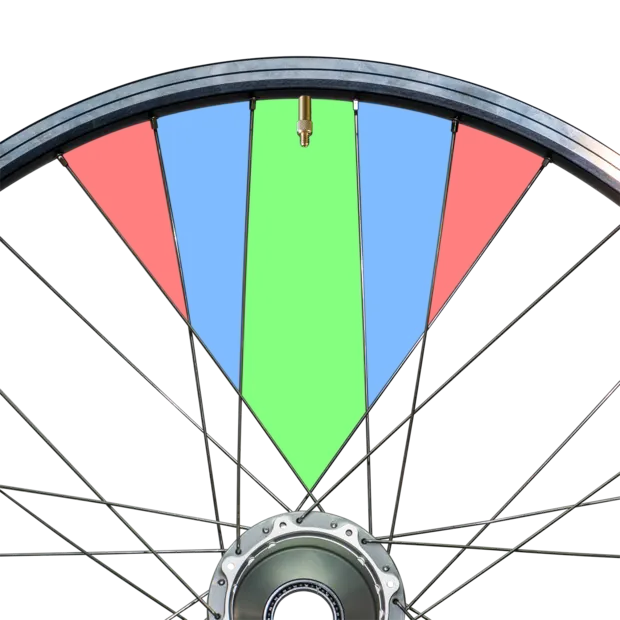
A 32- or 36-spoke wheel built with a SPEEDHUB is stiffer than a conventional rear wheel — roughly as strong as a 48-spoke tandem wheel. The hub’s flanges are symmetrical, the rim sits centred, and every spoke runs at the same angle with the same tension. For it to last decades, even in hard conditions, a few rules apply.
The rules
Section titled “The rules”- Crossing: two crosses for 26-inch rims and larger (650B, 28, 29), one cross for 24-inch and smaller. Never three, and never radial — the spokes have to carry drive torque too.
- Rim: 32 or 36 holes only, ideally a box-section aluminium rim with eyelets of at least 4.4 mm or holes drilled in the spoke direction. With small eyelets the nipple cannot align with the spoke, and the spoke kinks at the nipple.
- Spoke: the SPEEDHUB needs a 2.9 mm elbow length. In the aftermarket that is the 2.0/1.8/2.0 mm DD spoke; reinforced-elbow spokes (2.2 or 2.3 mm) need a 3.7 mm elbow length.
- Tension: at least 1,000 N with the tyre inflated (to working pressure), at least 1,300 N without it.
- Flange ring: always fit one before lacing — see below.
- Disc brake (DB) hubs need no different pattern on the disc side, because the shell is torsionally stiff.
- On rims of 24 inches and smaller, the spokes must not cross the shell cover screws.
Checking the spoke fit
Section titled “Checking the spoke fit”The wrong elbow is the flange’s worst enemy:
- elbow too long, or wire too thin at the elbow: the spoke can move axially after truing and the elbow opens up — spoke breakage;
- elbow too short, or wire too thick at the elbow: lacing and tensioning dent the flange hole — flange cracks.
To check: lace a spoke from the outside on the cover-side flange so its head sits in the countersink with no noticeable resistance. Hold the hub horizontal, sprocket side up, spoke pointing radially outwards — its threaded end should then sit within the factory range. Repeat with a spoke laced from the inside on the sprocket-side flange. The causes of flange damage are described in Fault diagnosis.
Flange rings
Section titled “Flange rings”The flange ring supports the spoke flange from outside: should the flange ever crack, it stops the spoke tearing out. Especially recommended for tandems, touring bikes, e-bikes, cargo bikes and riders over 100 kg — and mandatory from the second lacing on. It is black anodised aluminium (20 g).
Which kit you need is shown by the “Made in Germany” lettering on the shell:
| Lettering | Kit | Contents |
|---|---|---|
| underlined | Art. no. 8524 | 1 small + 1 large ring (groove towards the cover) — only the cover-side flange is raised |
| not underlined | Art. no. 8523 | 2 small rings — both flanges are the same |
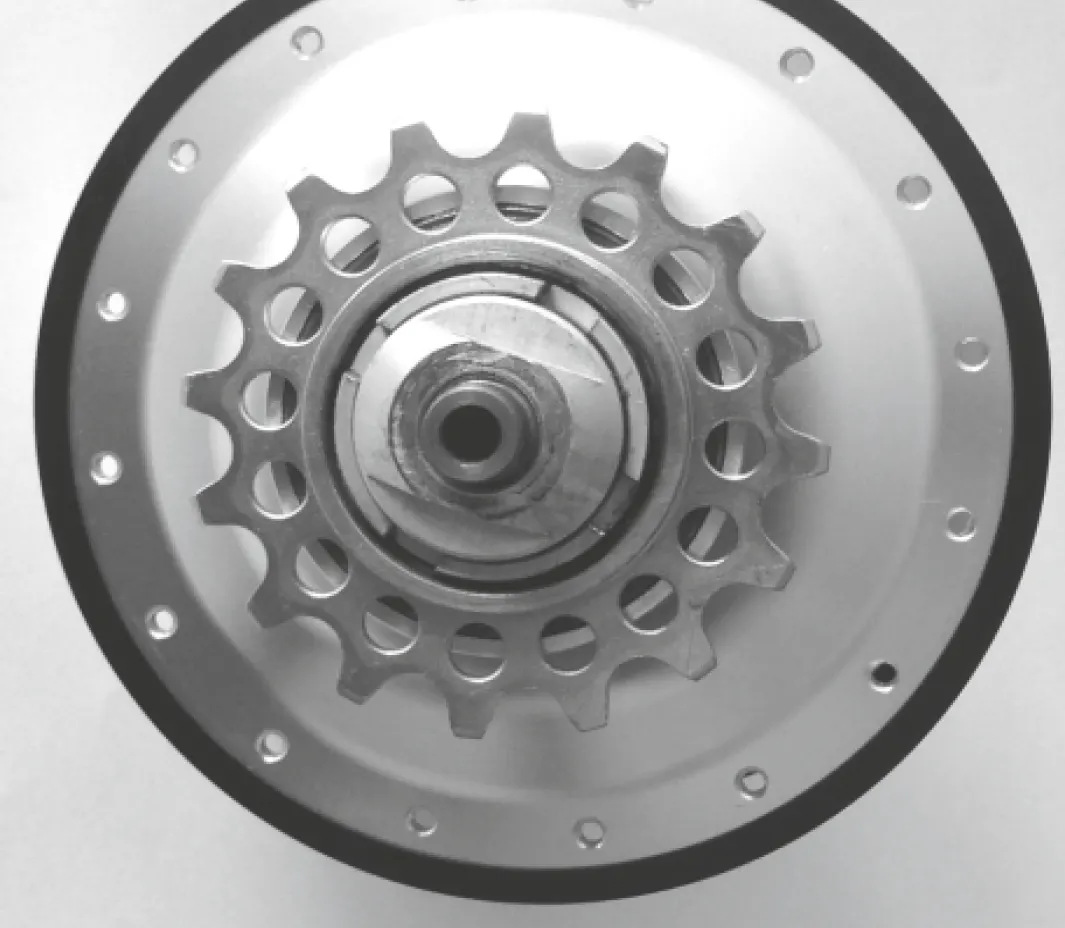
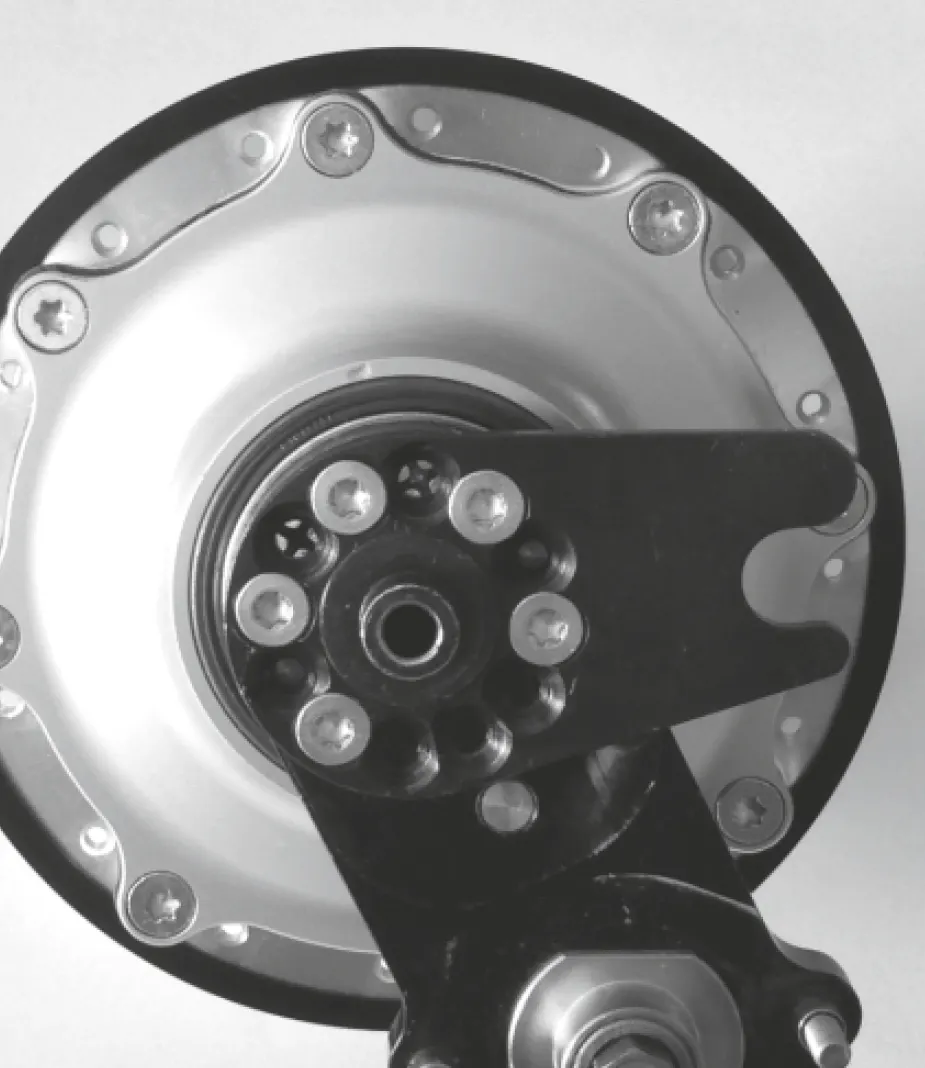
The 8523 kit is for hubs below these serial numbers:
| Colour and holes | Below serial no. |
|---|---|
| silver, 32 holes | 196922 |
| silver, 36 holes | 198454 |
| black, 32 holes | 196713 |
| black, 36 holes | 196521 |
| red, 32 holes | 197520 |
| red, 36 holes | 197980 |
Spoke length
Section titled “Spoke length”The SPEEDHUB’s flange circle is 100 mm, its spoke holes 2.7 mm (2.5 mm up to serial number 44321). With symmetrical flanges, every spoke is the same length. The tables below apply to 135, 142 and 148 mm hubs, by effective rim diameter (ERD).
32 spokes
Section titled “32 spokes”| Wheel size | Crosses | ERD (mm) | Spoke length (mm) |
|---|---|---|---|
| 18” | 1 | 341–343 | 128 |
| 344 | 130 | ||
| 20” | 1 | 372–373 | 142 |
| 374–377 | 144 | ||
| 378–381 | 146 | ||
| 382–385 | 148 | ||
| 386–389 | 150 | ||
| 390–394 | 152 | ||
| 24” | 1 | 472–476 | 192 |
| 477–480 | 194 | ||
| 481–484 | 196 | ||
| 485–489 | 198 | ||
| 490–493 | 200 | ||
| 494–497 | 202 | ||
| 498–501 | 204 | ||
| 502–503 | 206 | ||
| 26” | 2 | 516–519 | 226 |
| 520–523 | 228 | ||
| 524–527 | 230 | ||
| 528–531 | 232 | ||
| 532–535 | 234 | ||
| 536–539 | 236 | ||
| 540–543 | 238 | ||
| 544–547 | 240 | ||
| 548–551 | 242 | ||
| 552–555 | 244 | ||
| 650B | 2 | 556–559 | 246 |
| 560–563 | 248 | ||
| 564–567 | 250 | ||
| 568–571 | 252 | ||
| 572–575 | 254 | ||
| 576–579 | 256 | ||
| 580–583 | 258 | ||
| 28” | 2 | 584–587 | 260 |
| 588–592 | 262 | ||
| 593–596 | 264 | ||
| 597–600 | 266 | ||
| 601–604 | 268 | ||
| 605–608 | 270 | ||
| 29” | 2 | 609–612 | 272 |
| 613–616 | 274 | ||
| 617–620 | 276 | ||
| 621–624 | 278 | ||
| 625–628 | 280 | ||
| 629–632 | 282 |
36 spokes
Section titled “36 spokes”| Wheel size | Crosses | ERD (mm) | Spoke length (mm) |
|---|---|---|---|
| 18” | 1 | 341–342 | 126 |
| 343–344 | 128 | ||
| 20” | 1 | 372–375 | 142 |
| 376–379 | 144 | ||
| 380–383 | 146 | ||
| 384–387 | 148 | ||
| 388–392 | 150 | ||
| 393–396 | 152 | ||
| 24” | 1 | 472–474 | 190 |
| 475–478 | 192 | ||
| 479–482 | 194 | ||
| 483–486 | 196 | ||
| 487–490 | 198 | ||
| 491–494 | 200 | ||
| 495–498 | 202 | ||
| 499–502 | 204 | ||
| 503 | 206 | ||
| 26” | 2 | 516–517 | 222 |
| 518–522 | 224 | ||
| 523–526 | 226 | ||
| 527–530 | 228 | ||
| 531–534 | 230 | ||
| 535–538 | 232 | ||
| 539–542 | 234 | ||
| 543–546 | 236 | ||
| 547–550 | 238 | ||
| 551–554 | 240 | ||
| 555–558 | 242 | ||
| 559–562 | 244 | ||
| 650B | 2 | 563–566 | 246 |
| 567–570 | 248 | ||
| 571–574 | 250 | ||
| 575–578 | 252 | ||
| 579–582 | 254 | ||
| 28” | 2 | 583–586 | 256 |
| 587–590 | 258 | ||
| 591–594 | 260 | ||
| 595–598 | 262 | ||
| 599–602 | 264 | ||
| 603–607 | 266 | ||
| 29” | 2 | 608–611 | 268 |
| 612–615 | 270 | ||
| 616–619 | 272 | ||
| 620–623 | 274 | ||
| 624–627 | 276 | ||
| 628–631 | 278 |
XL and XXL hubs (170–197 mm), 32 spokes
Section titled “XL and XXL hubs (170–197 mm), 32 spokes”Fatbike rims have their spoke holes offset from the rim’s centre, so the length depends on the offset too. From 585 mm ERD — so not with a 29” rim either — there is no suitable spoke length for an XL/XXL hub.
| Wheel size | Crosses | ERD (mm) | 12.5 mm offset (mm) | 20 mm offset (mm) |
|---|---|---|---|---|
| 26” | 2 | 516–519 | 228 | 226 |
| 520–523 | 230 | 228 | ||
| 524–527 | 232 | 230 | ||
| 528–531 | 234 | 232 | ||
| 532–535 | 236 | 234 | ||
| 536–539 | 238 | 236 | ||
| 540–544 | 240 | 238 | ||
| 545–548 | 242 | 240 | ||
| 549–552 | 244 | 242 | ||
| 553–556 | 246 | 244 | ||
| 650B | 2 | 557–560 | 248 | 246 |
| 561–564 | 248–250 | 248 | ||
| 565–568 | 250–252 | 250 | ||
| 569–572 | 252–254 | 252 | ||
| 573–576 | 254–256 | 254 | ||
| 577–580 | 256–258 | 256 | ||
| 581–584 | 258–260 | 258 |
If your rim is not in the table, calculate it:
L = √(0.25·d² + 3400 − 50·d·c)
where d is the rim diameter at the nipple seat (mm), and c is 0.924 (32 holes) or 0.940 (36 holes) for one cross, 0.707 (32 holes) or 0.770 (36 holes) for two. Example: d = 539 mm, 32 holes, two crosses → L = 238.69 mm, so 238 mm (always rounded to an even length).
To measure d: measure the nipple head height (K) and the length of two spokes from the start of the thread to the inside of the bend (S). Put them through two opposite rim holes, screw the nipples on until flush with the spoke end, pull the two spokes together in the middle of the rim and measure the distance X between them: d = 2·S + X − 2·K.
Frequently asked questions
- How many crosses for a SPEEDHUB wheel?
- Two crosses for 26-inch and larger rims (650B, 28, 29 inch), one cross for 24-inch and smaller. Never three crosses and never radial: with the SPEEDHUB's large flange circle the spoke would meet the rim too flat, and the spokes must transmit drive torque too.