
Gear ratio comparison
Two numbers decide a gear system. The overall range — the ratio between highest and lowest gear — tells you which climbs you can manage and how fast you can pedal. The step — the difference between neighbouring gears — tells you how well you keep momentum and a comfortable cadence when shifting. With a range above 500% and gears that follow each other evenly in steps below 15%, you can always shift to the right gear in time.
The example
Section titled “The example”A 29” mountain bike (2.30 m circumference), once with a 2×10 derailleur (22 and 38-tooth chainrings, 11–36 cassette) and once with a SPEEDHUB (40-tooth chainring, 17-tooth sprocket). The figures are calculated from the tooth counts and the SPEEDHUB’s ratios.
Of the derailleur’s 20 combinations only 14 distinct gears remain: the small ring with the 14, 12 and 11-tooth sprockets, and the large ring with the 36, 32 and 28, give much the same as a combination on the other ring. So both systems work with the same number of real gears:
| Property | 2×10 derailleur | SPEEDHUB 500/14 |
|---|---|---|
| Real gears | 14 (of 20 combinations) | 14 |
| Distance per crank turn | 1.41–7.95 m | 1.51–7.94 m |
| Overall range | 565% | 526% |
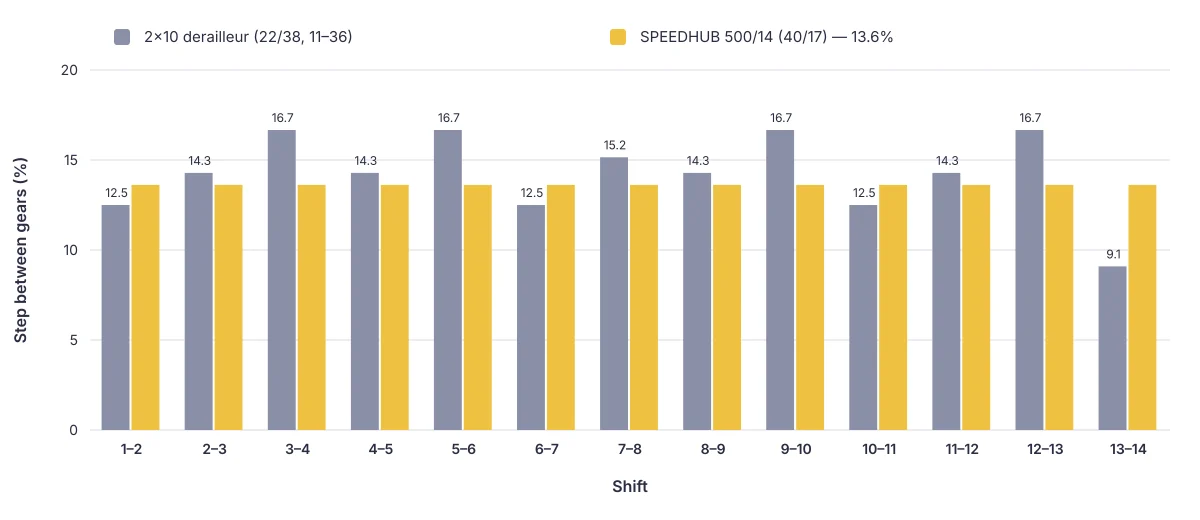
| Step between gears | 9–17%, uneven | 13.6%, always the same |
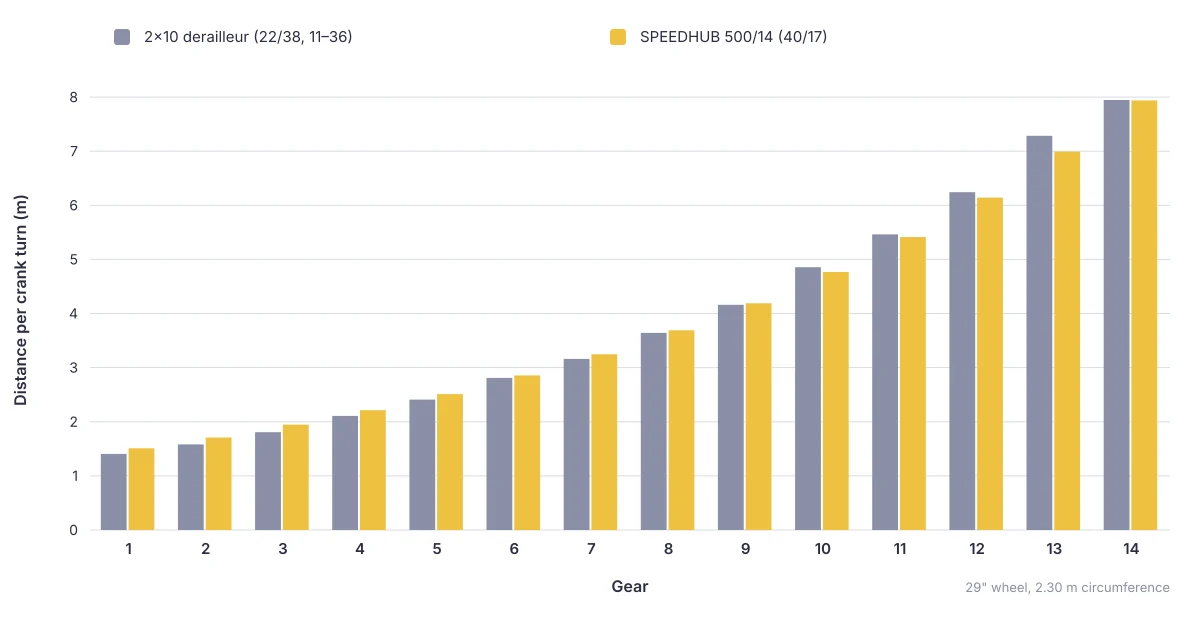
The range is almost the same. The difference is in the steps: on the derailleur the next gear is sometimes 9% away, sometimes 17%, and the 7–8 shift means changing chainring while stepping back two or three sprockets. Every SPEEDHUB step is 13.6%.
Gear by gear
Section titled “Gear by gear”| Gear | Derailleur: chainring / sprocket | Derailleur: distance (m) | Step | SPEEDHUB: distance (m) | Step |
|---|---|---|---|---|---|
| 1 | 22 / 36 | 1.41 | — | 1.51 | — |
| 2 | 22 / 32 | 1.58 | 12.5% | 1.71 | 13.6% |
| 3 | 22 / 28 | 1.81 | 14.3% | 1.95 | 13.6% |
| 4 | 22 / 24 | 2.11 | 16.7% | 2.21 | 13.6% |
| 5 | 22 / 21 | 2.41 | 14.3% | 2.51 | 13.6% |
| 6 | 22 / 18 | 2.81 | 16.7% | 2.86 | 13.6% |
| 7 | 22 / 16 | 3.16 | 12.5% | 3.25 | 13.6% |
| 8 | 38 / 24 | 3.64 | 15.2% | 3.69 | 13.6% |
| 9 | 38 / 21 | 4.16 | 14.3% | 4.19 | 13.6% |
| 10 | 38 / 18 | 4.86 | 16.7% | 4.77 | 13.6% |
| 11 | 38 / 16 | 5.46 | 12.5% | 5.41 | 13.6% |
| 12 | 38 / 14 | 6.24 | 14.3% | 6.14 | 13.6% |
| 13 | 38 / 12 | 7.28 | 16.7% | 6.99 | 13.6% |
| 14 | 38 / 11 | 7.95 | 9.1% | 7.94 | 13.6% |
The derailleur changes chainring at the 7–8 step (22 → 38) — the table shows the real gear sequence, without the overlapping combinations.
What the table does not show
Section titled “What the table does not show”- On the SPEEDHUB you reach any gear in one movement, skipping several if you like, even standing still — you leave the red light already in the right gear.
- You can shift the range faster or slower by changing chainring and sprocket, just as on a derailleur. For the smallest permitted ratio, see Chainline and gearing.
- How the gears come together inside: The 14 gears inside.
Frequently asked questions
- Are the SPEEDHUB's 14 gears enough to replace a 2×10 derailleur?
- Yes. Of a 2×10 derailleur's 20 combinations only 14 distinct gears remain; the rest overlap. The SPEEDHUB's 526% range is almost the same as a 22/38, 11–36 2×10 system, but all 14 gears step by an equal 13.6%, and you can reach any of them in one movement, even standing still.